I recently took my kids to see the new animated movie King of Kings distributed by Angel Studios (a Mormon Company). The story follows Charles Dickens retelling of Jesus’ life for his own children in his writing The Life of Our Lord. With Dicken’s being an Anglican turned Unitarian and Angel Studios being Mormon, the potential for heretical doctrine was high–particularly surrounding the doctrine of the Trinity and the nature of Jesus and His saving work. However, I believed the most influential doctrinal voice would come from the producer and co-writer, Woo Hyung Kim, a South Korean who claims to be Christian. As it is difficult to find out more about his denominational or doctrinal background, I realized the best way to understand his theology was to actually watch the film.
As a parent of small children, I know I must shepherd my children by guarding what and when they take in certain ideas and guiding them in understanding and evaluating what they take in. Religious films can be particularly dangerous because they can easily mingle false doctrine with strong emotions. Rather than always shielding children from harmful ideas, I believe a helpful method of shepherding them is to allow them to be exposed to various ideas at age and maturity appropriate times, and walking through the ideas with them, helping them to evaluate those ideas from a biblical perspective. In our household, its not unusual for us to pause a movie and ask the kids evaluative questions like: How does this make you think of Jesus? What was wrong with that action or that idea? What does God’s Word say about that? And following those questions with some discussion and guidance.
Overall, I can recommend parents take their children to see King of Kings. However, parents will want to discuss the movie with their children afterward to make explicit some things that were lacking and to take the opportunity to talk about salvation and gauge their children’s readiness to be saved.
Here are some commendable elements of the movie:
- Jesus is clearly presented as the Son of God. This is stated over and over again and it shows that Jesus has a very close relationship to God. As the Son of God, Jesus is presented as “the True King” by Dickens’ wife. He is shown to have miraculous power to heal, to forgive sins, to cast out demons, to command nature.
- The depictions of the Passover and the Creation and Fall of mankind are very well done. The change in animation is beautiful and gives a good contrast from the retelling of Jesus’ time to the time of the past. However, the strength of the retelling of these two events is in how the movie does Biblical theology. The Passover is used to set the stage for Jesus being presented as the Lamb of God who takes away the sin of the world. Later, when Dickens’ son is very upset that Jesus has to die and asks why, Dickens rightly retells the creation and fall of mankind into sin from Genesis 1-3 to answer that Jesus had to die because of the sin of mankind–because sin has separated us from God and from life.
- Salvation is presented as being in relationship with Jesus. Just as Jesus said that eternal life is knowing God and knowing Jesus, the movie presents this in a unique way. My wife Sarah pointed this out to me as we watched and it is masterfully done. As Dickens tells his son about Jesus, his son is transported into the story–watching the events take place. The further into the story they get, you see Jesus starting to interact with the boy (e.g. protecting him from harm, finding the boy’s missing cat which he cares about dearly, etc.) and the boy starting to interact with Jesus. By the end of the story, the boy is presented as having a heartfelt saving relationship with Jesus.
- Jesus is presented as offering substitutionary atonement. As I mentioned above, Jesus is presented as having come because of the sin of mankind–to take it away. The characters state that Jesus came “to die for all our sins” and as the paschal lamb who would die in our place. The movie shows Jesus being crucified to offer salvation. Dickens tells his son “this is why God gave His only beloved Son.” At the end of the story, Dickens’ son is presented as drowning. In this scene, the movie calls back to previous scenes of Jesus’ baptism and Peter sinking in the water when he began to focus on the storm. But as the boy sinks deeper into the water to drown, Jesus goes down, grabs him, trades places with him, and pushes him to the surface of the water to save him. Warning: this scene is a real tear-jerker.
- Salvation is presented as being obtained by faith in Jesus. There are many times throughout the movie that faith is highlighted as the way to receive salvation very explicitly. Jesus says to Peter and to the boy, “Have faith in me and you will be saved.” Jesus forgives the sins of those who have faith. I didn’t catch any hint of salvation being obtained through works or through sacrament because the statements about salvation coming through faith in Jesus were so strong and so clear.
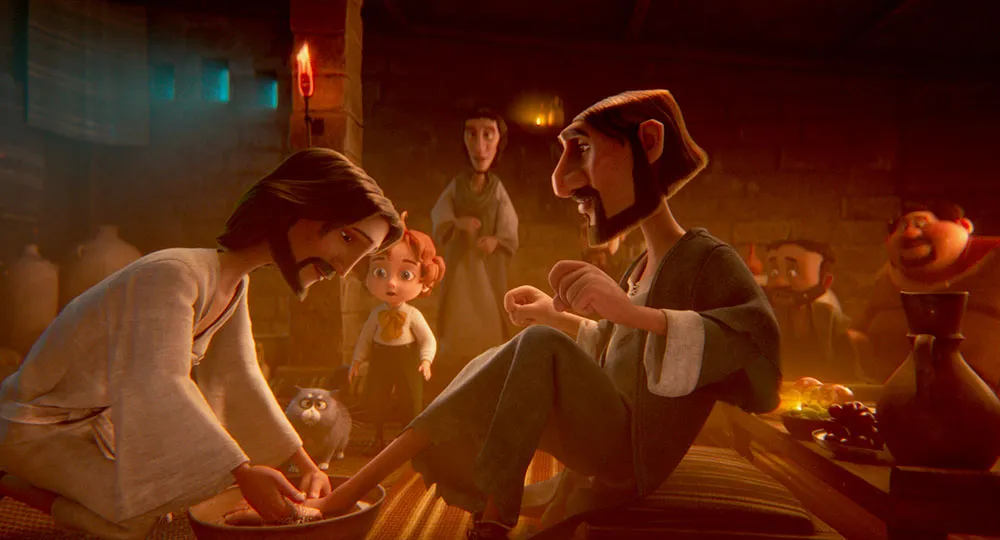
- The depiction of Dickens’ family presents a spiritually healthy model of marriage and family. At the beginning of the movie, we see a rift between Dickens and his son because the son is misbehaving and Dickens overreacts. I think all parents have been there. However, when they arrive home after the rift, Dickens’ wife is presented in a godly way–encouraging her husband to initiate reconciliation with his son through telling him about “the True King.” My wife Sarah and I agree that this is a helpful picture of godly womanhood. While Dickens tells his son about Jesus, his wife is involved and offers encouragement but allows her husband to lead as the parents teach their son about Jesus. There is a scene that I thought was particularly sweet when Dickens was recounting Jesus washing the disciples feet and he pretends to be washing his sons’ feet and the boy laughs because it tickles. This is a precious picture of fathers spiritually shepherding their children as Deuteronomy 6 teaches us. Another beautiful picture here happens when the story is finished and the boy is so excited about Jesus that he runs to the bedroom of his siblings, jumps on their beds, waking them up, and begins to excitedly tell them about Jesus. There is a picture of evangelism in this.
While there is much to commend about King of Kings, there are also some areas where it is lacking clarification:
- The deity of Jesus is not clear. While the movie states emphatically that Jesus is the Son of God, it does not state that He is God the Son. There are many cults today that affirm Jesus’ sonship but not his deity. Anyone who cannot affirm that Jesus is God is not a Christian in any true, historical, or saving sense. Now, I have to clarify that while the movie does not state that Jesus is God, it presents Him doing things that, according to the Old Testament, only God can do, such as commanding nature. However, there are times when Jesus’ nature could be easily confused. One could walk away thinking that Jesus, as God’s Son, was not God but a man of great faith. At one point, after Jesus forgives the sins of the paralytic, Dickens explains to his son that the Pharisees were mad because, “They thought only God could forgive sins.” This statement could easily be construed to imply that Jesus is not God. The biblical reasoning for the healing of the paralytic was not stated but should have been–that since only God can forgive sins and Jesus was forgiving sins, then Jesus is God. This was the gospel writers’ point in recording Jesus healing the paralytic but the movie swung and missed on this one. The lack of clarity on the deity of Jesus is the most dangerous aspect of this film.
- The movie changes Mark 10:45 in a theologically significant and harmful way. Mark 10:45 says, “For even the Son of Man did not come to be served, but to serve, and to give His life a ransom for many.” But the movie changes the word “ransom” to the word “benefit.” The word “ransom” in the Greek New Testament is λύτρον (Lutron). It speaks of paying the price to buy a slave’s freedom. I understand that this is a hard concept for a child to understand but the word “benefit” does not do justice to the theological nature of the term used by Mark, nor is it faithful or warranted. The biblical term reveals that the sinner is enslaved to his sin and cannot free himself but that another must pay the price for his freedom. The redemption price is the very life of Jesus. Thankfully, the movie displays the substitutionary atonement fairly well which is connected to the idea of ransom although they are not the same. Discussing this verse and the unfaithful change is a good teaching moment.
- There are some inaccuracies in the events displayed. Since the movie is not claiming to be the Bible or the inspired Word of God, they are able to (and in some cases, out of the necessity of showing rather than telling must) take artistic license. However, there are some strange errors. The ones that stick out the most are those surrounding the portrayal of Jesus’ birth: the wise men coming the night of Jesus’ birth (it was more likely two years after his birth) and only three wise men (it was likely closer to 40 wise men), etc.
- The temptation of breaking the first two commandments is ever present in any visual portrayal of Jesus. We must always guard our hearts (and our children’s hearts) from worshipping a creative image or portrayal of Jesus rather than the true, biblical Jesus. As hard as the creators of this movie try to portray Jesus accurately, they will fail in some ways. The only accurate picture of Jesus we can have and are allowed to worship, is the Jesus of the Bible. While we can watch the movie and have our faith encouraged and enriched by it, we should never allow this animated Jesus (or any actor who portrays Jesus such as Jonathan Roumie in The Chosen or Jim Caviezel in The Passion, or any other) to become the object of our adoration. And we must be careful because the human heart is deceptive. It is easy for our conception of Jesus to slide from the true, biblical Jesus, to a Jesus we see on a screen, in a painting, or engraved in stone. We must be ever careful not to worship the false god of an imaginary Jesus or create a mentally-graven image of him to worship.
Considering the commendable and the lacking aspects of King of Kings, I would encourage families to see the movie. Use it as an opportunity to practice Deuteronomy 6 and Ephesians 6:4 teaching your children about right doctrine and good theology–affirming what you can in the movie while clarifying and correcting what you need to. Have discussions about Jesus, the Bible, and salvation. Use it as an opportunity to ask your child open-ended questions to check their understanding and readiness to receive the gospel.
 ericfannin.com
This is a great and well-written exposition. Thanks for sharing!